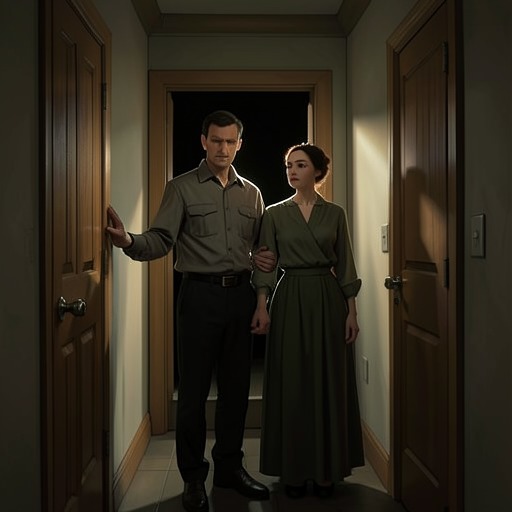
Suspicion and Crisis of Trust in Marriage
CEO's Beloved Honey GirlSuspicion and Crisis of Trust in Marriage is one of the central pressures shaping the relationship between Su Xiangwan and Lu Xun. Their marriage is shadowed by secrecy, unequal emotional histories, outside attachments, and the public logic of money and reputation. Trust is therefore not a settled condition but a negotiation repeatedly reopened by absences, ambiguous relationships, accusations, illness, and the question of whom Lu Xun will protect when competing loyalties collide.
Secrecy, Status, and the Grounds for Suspicion
The marriage begins under conditions that make confidence fragile. Lu Xun recognizes the connection between celebrity and financial backer after encountering Luo Jingjing, and the entertainment industry’s supposedly ordinary arrangements become morally charged when he sees Su Xiangwan placed in a comparable position. The issue is not merely private jealousy: Su Xiangwan’s dignity is entangled with the Su Clan’s financial foundation, while Lu Xun worries that preserving the family enterprise could require her to endure humiliation. Marriage, capital, and reputation thus become inseparable sources of pressure.
The hidden status of the marriage gives every outside conversation additional force. When Song Yun’er discusses the secret marriage with Lu Xun while Su Xiangwan is present, Su Xiangwan objects that such a conversation should not take place in front of the wife whose relationship with Song Yun’er has not reached the point of discussing men. Her complaint is controlled and mocking rather than openly explosive, but the restraint makes the boundary clearer: the marriage exists, yet secrecy allows an older intimacy to behave as though it still has priority.
That social ambiguity is reinforced by the spectacle of other couples. At the Bridal Shop, Su Xiangwan and Su Qingrou hear Song Yun’er admire a wedding dress with a colored diamond at the waist, after which Lin Yanche promises to buy it for her. The scene places romantic display, marriage imagery, and rival attachments in the same public space. For Su Xiangwan, the wedding dress is not an abstract symbol; it is a visible reminder that declarations and material gestures can be directed toward someone outside the formal marriage bond.
The Cycle of Accusation and Reassurance
The crisis develops through repeated testing. When Lu Xun asks whether Su Xiangwan is still angry, she answers that if he already knew she would be angry, he would nevertheless do what angered her. Her accusation is aimed at the gap between his supposed care and his conduct. Lu Xun admits that he regrets having spoiled her and allowed her to move back, revealing that domestic closeness has made her less willing to accept his unilateral decisions. What appears as reconciliation remains conditional because his tenderness has not eliminated the behavior that produced distrust.
His later attempt to explain his relationship with Shen Yiyun follows the same pattern. Lu Xun identifies Shen Yiyun as his cousin, an adopted child of his uncle, and explains that he arranged nearby housing because she had come to Cloud City to perform. Su Xiangwan reproaches him for failing to tell her directly, comparing the omission to the earlier situation involving Song Yun’er. The explanation reduces one suspicion, but the need for explanation confirms the larger problem: information withheld by Lu Xun becomes a form of evidence against him, even when the relationship itself is familial.
The argument over cohabitation exposes how quickly responsibility can be reversed. Su Xiangwan calls Lu Xun hypocritical after he objects to her description of his living arrangement with another woman. He answers that she had insisted on staying away the previous day, implying that her absence caused the misunderstanding. She rejects the idea that this means she must unconditionally accept the two of them living together. The dispute is therefore not only about physical proximity; it concerns whether the wife can be blamed for the husband’s failure to maintain clear boundaries.
Song Yun’er and the Persistence of the Past
Song Yun’er represents the unresolved history that continually enters the marriage. She begs Lu Xun for help while admitting that she is not like him and could not casually marry or settle for a woman who angered her. She describes herself as abandoned and claims to have received retribution for her mistakes. Lu Xun answers with cold laughter and a comparison of their ugliness, turning her appeal into a contest over blame and humiliation. Their exchange shows that the past is not simply remembered affection. It is also resentment, guilt, dependence, and a claim upon Lu Xun’s conscience.
Even when Lu Xun tells Su Xiangwan that Song Yun’er is not important, he insists that they cannot stand by and watch her suffer. He explains that they grew up together and that their shared past remains outside the present situation. Su Xiangwan permits him to go, but the permission does not erase the conflict. Lu Xun’s distinction between emotional importance and moral obligation may be sincere, yet it leaves Su Xiangwan facing the practical consequence: when Song Yun’er is endangered, her husband leaves to respond.
Song Yun’er’s accusations also reveal how rivalry is mediated through public and sexual reputation. During a phone call, she claims that Lu Xun’s concern with Su Xiangwan involves dirty matters more important than her own affairs and says that she looks down on him before hanging up. The language converts marital and sexual suspicion into a weapon. Earlier, Lu Xun had encountered the entertainment world’s association between women and financial backers; now Song Yun’er uses insinuation to define what Lu Xun and Su Xiangwan’s relationship means. Whoever controls the accusation temporarily controls the moral frame.
Bodies, Care, and Unequal Vulnerability
Trust is further strained when the body becomes a record of coercion or neglect. Su Qingrou is confined in a manor after Lin Yanche threatens that Jin Zhengnan will never leave the Hospital if she steps outside. He links her freedom to another man’s medical vulnerability, turning care and violence into instruments of control. When Su Xiangwan sees Su Qingrou weeping silently and notices deep and shallow kiss marks on her body, her pain is immediate. The physical evidence makes secrecy impossible: the crisis of trust is not merely imagined suspicion but a response to visible harm.
The contrast with Su Xiangwan’s own illness is revealing. After sleeping without adequate covering, she wakes with a fever, body aches, and too little strength, then asks Manager Wu to buy antipyretic medicine. Her fever makes her dependent, but the surrounding concern frames her as someone to be cared for rather than someone whose body can be possessed or used as leverage. Across these situations, bodily condition changes the balance of marriage and family: illness can invite protection, while marks of coercion expose the failure of protection.
The most direct condemnation comes from Mo Beiyu, who finds Su Xiangwan unconscious by the roadside after Lu Xun has tortured her to such a condition that a body-identification notice might otherwise have been necessary. Mo Beiyu calls Lu Xun a rapist and challenges his right to stand in sunlight. The confrontation makes explicit what possessive marital language can conceal: a marriage does not transform coercion into care, and emotional claims do not cancel bodily injury or the victim’s lack of consent.
The Limits and Possibilities of Repair
The relationship nevertheless contains gestures that interrupt, without fully resolving, the cycle of distrust. Lu Xun embraces Su Xiangwan from behind and explains that Shen Yiyun is only his younger sister, asking her to give him some face while he coaxes her. His language relies on intimacy and playfulness, but it also acknowledges that reassurance must be performed. Affection is not presented as proof that suspicion was irrational; it is an attempt to rebuild a damaged emotional arrangement.
The strongest repair gesture comes after Lu Xun is injured and hospitalized. He kisses Su Xiangwan publicly, holds her tightly, and says that he needs her and asks her to stay with him. She responds that Song Yun’er is enough to accompany him and that Song Yun’er would be more at ease with him, emphasizing the rivalry that still structures her view of his loyalties. Lu Xun answers that he cannot care for himself without Su Xiangwan and has no reason to ask Song Yun’er to return. His pleading reverses the earlier pattern in which Song Yun’er demanded his attention: he now makes Su Xiangwan’s presence the condition of his own vulnerability.
The concept therefore refuses a simple movement from suspicion to certainty. Lu Xun’s explanations, embraces, and requests for care create moments of renewed closeness, but the marriage remains shaped by hidden status, rival claims, coercive power, and the possibility that love will be invoked to excuse control. Suspicion is not merely a personal flaw in Su Xiangwan; it is a rational response to a relationship in which information is withheld, boundaries are contested, and protection is distributed unevenly. Trust can return only through changed conduct and recognized autonomy, not through reassurance alone.